
A Simple Monthly Bookkeeping Checklist for Small Business
Why a monthly close matters
If you wait until April to catch up the books, you are not just sorting paperwork. You are guessing what last summer’s bank charge was for — and doing it under deadline pressure.
A light monthly close fixes that. Once a month, you make sure the books match the bank, expenses have categories, and personal spending is not mixed into business costs. Tax time then becomes a review, not a scavenger hunt.
This checklist is for small-business owners who do their own books, or who work with light bookkeeping help. It is a practical habit you can finish in one sitting — not a software tutorial, and not tax advice. If something will not balance, stop guessing and talk to your bookkeeper or tax pro.
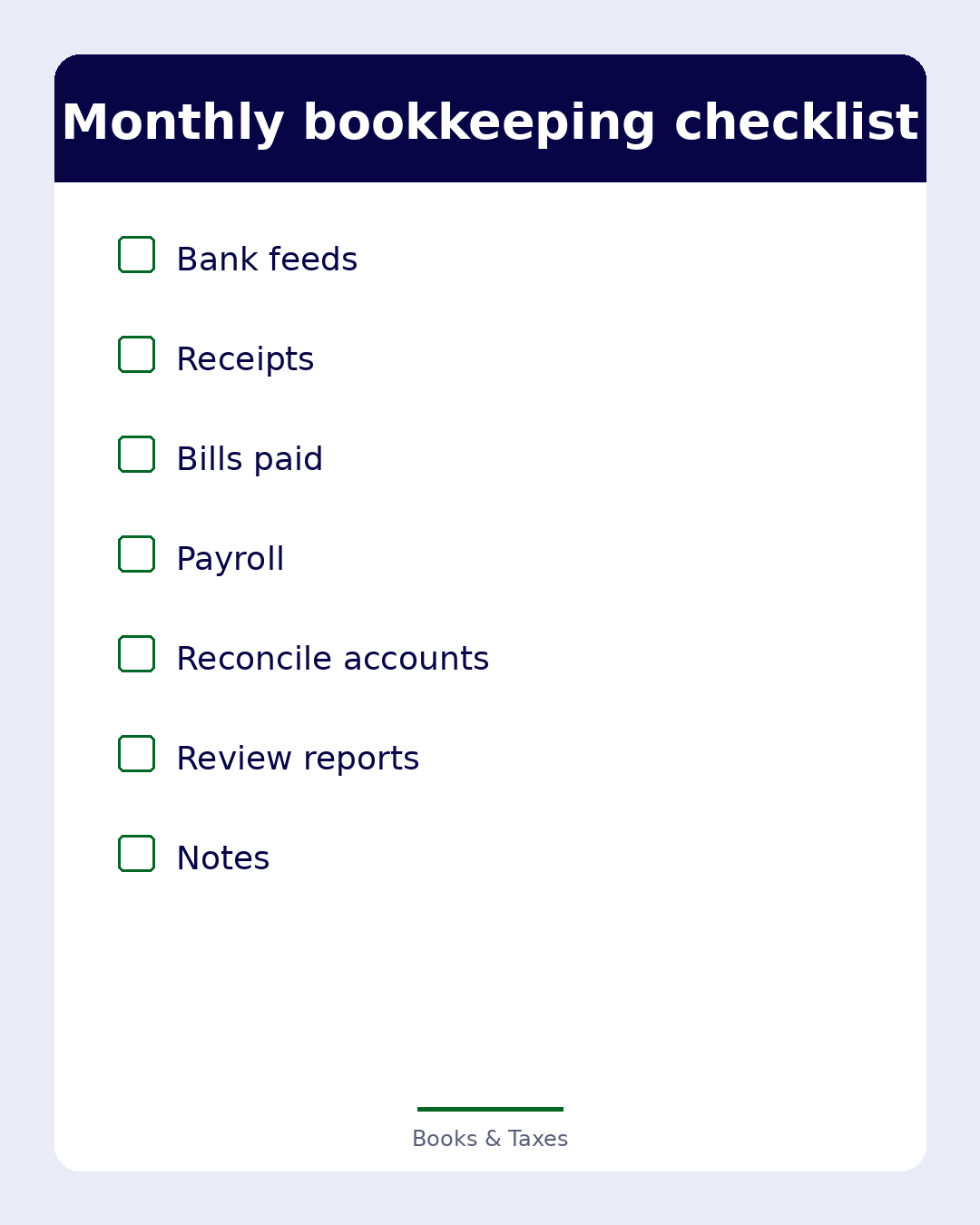
Your monthly bookkeeping checklist
Work through these in order. Check each item off before you call the month done.
1. Export bank and card statements
Pull statements (or PDFs) for every business bank account and credit card for the calendar month you are closing. Save them somewhere you can find later — a dated folder works fine.
You need the statement ending balance and the full list of transactions. Screenshots from the app are weaker than a real statement when something does not match.
2. Reconcile each account to the statement ending balance
In your books, reconcile each account so the cleared balance matches the statement ending balance for that month.
If it will not match, do not force it. Find the missing transaction, duplicate, or timing difference first. A forced “adjustment” you cannot explain usually shows up again later — often at tax time.
3. Categorize everything still sitting in Uncategorized
Go through uncategorized (or “ask my accountant”) transactions. Give each one a real expense or income category.
Uncategorized piles grow quietly. A monthly pass keeps them small and keeps your profit-and-loss report useful.
4. Separate personal vs. business
Scan for personal charges on business accounts (or business charges on personal ones). Move or reclassify them so the books show business activity only.
Mixed accounts are one of the fastest ways to create messy books and awkward questions later. If personal and business money are tangled every month, that is a process problem — not just a categorization chore.
5. Record cash and missing receipts
Add cash sales or cash expenses you have not recorded yet. Note missing receipts so you know what still needs backup.
You do not need a perfect receipt for every coffee. You do need a clear trail for material costs, vendor payments, and anything you may need to support later.
6. Match deposits to invoices (if you invoice customers)
If you send invoices, tie deposits to open invoices for that month. Mark paid what was paid. Note anything still outstanding.
This keeps accounts receivable honest. It also stops mystery deposits from sitting in income with no customer attached.
7. Match bills to payments (if you track bills)
If you enter bills, match payments to those bills. Confirm what is still unpaid.
Same idea as invoices: your payables list should reflect reality, not last quarter’s leftovers.
8. High-level payroll check (if you have employees)
If you run payroll, do a quick compare: does payroll expense in the books look roughly in line with your payroll reports for the same month?
You are not doing a full payroll reconciliation here — that is its own monthly habit. You are only catching obvious gaps (a payroll run missing from the books, or wages posted with no matching report). For a fuller walkthrough on keeping payroll and the books in sync, see the companion post: How bookkeeping and payroll should talk to each other each month.
Do not invent deposit dates, tax rates, or filing deadlines while you skim.
9. Skim the P&L and balance sheet for odd spikes
Open your profit and loss (income statement) and balance sheet for the month. Look for categories or balances that look off: a sudden spike, a negative that should not be there, or a balance that never moves when it should.
You are not auditing. You are noticing. Odd lines are easier to fix now than six months from now.
10. Save a month-end folder and short notes
Store statements, reconciliations, and a few bullet notes: what you fixed, what is still open, and anything to ask your bookkeeper or tax pro.
That folder is a gift to future you — and to whoever prepares your return.
Make it a habit, not a marathon
Pick a recurring day each month — many owners use the first week of the following month — and protect that block. Closing one month while the details are still fresh is almost always easier than catching up three months at once.
If a month is messy, finish the checklist as far as you can, list what is blocked, and get help on the blockers. Skipping the whole close because one account will not reconcile usually makes next month worse.
Red flags worth a pause
Stop and get a second set of eyes if you see any of these:
- A bank or card account that will not reconcile after you have checked for duplicates and missing entries
- Regular personal spending on business accounts (or the reverse) with no clear repayment trail
- Large uncategorized or “ask my accountant” balances that keep growing
- Payroll in the real world with little or no payroll activity in the books (or the opposite)
- Loans, owner draws, or transfers you cannot explain in plain language
- Sales tax, payroll tax, or other trust-fund style amounts you are unsure how to treat
None of these mean you failed. They mean the books need a cleaner process — or a pro — before the pile gets bigger.
When to get help (and what this is not)
If a reconcile will not balance, or personal and business funds are mixed, talk to your bookkeeper or tax professional. That conversation is cheaper than guessing.
This checklist is educational, not tax, legal, or accounting advice for your specific situation. Rules and forms change, and California employers and sales-tax collectors have extra details that depend on your facts. When a step touches tax filings, deposits, or how to classify owner money, confirm with a qualified pro.
Do the ten steps every month. Keep notes. Ask for help when something will not add up. That is how small-business books stay usable — and how tax season gets quieter.