Traditional vs Roth 401(k): Same Paycheck, Different Retirement, and Why Your Future Tax Rate Decides
The short answer
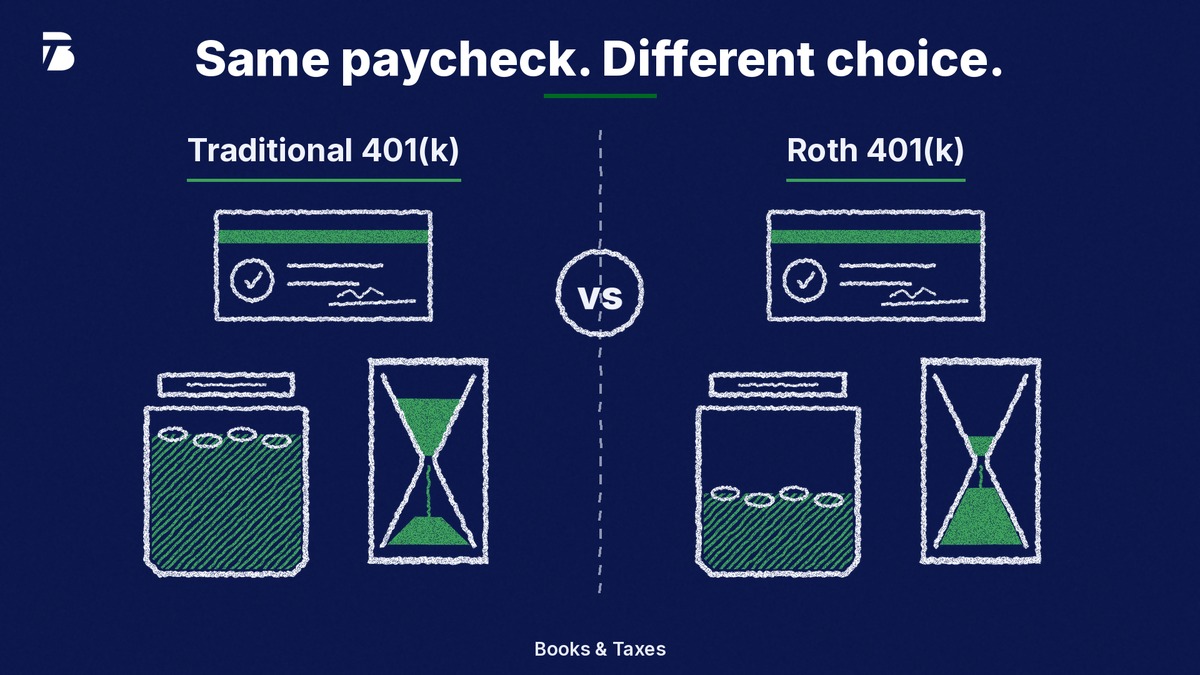
Is a Roth or traditional 401(k) better? It depends on your tax rate in retirement compared with the tax you save now.
In our illustrative example, two friends live the same lifestyle before and after retirement. At a cautious 21% retirement tax rate, the traditional 401(k) lasts about 28 years and the Roth about 19. If the retirement tax rate matches the 33.3% saved while working, they tie. Above that, the Roth wins.
So don't judge a 401(k) by its balance. Judge it by how much after-tax income it gives you in retirement.
Two friends, same paycheck
Meet Jake and Marie. They're made up for this example, not real clients.
Both are single, live in California, and earn $150,000 a year. Both take the standard deduction and have no other income, credits, or employer match. We use 2026 tax rules.
Before any 401(k) contribution, each owes about:
- Federal income tax: $24,734 (after the $16,100 standard deduction)
- California income tax: $9,560.86 (after the $5,900 standard deduction and $158 personal credit)
- Payroll taxes: $13,425 (6.2% + 1.45% Medicare + 1.3% California SDI)
That leaves each with $102,280.14 of take-home pay. These are estimates of yearly tax owed, not paycheck withholding.
Catch 1: same lifestyle, bigger traditional contribution
Marie puts 10% of her salary, $15,000, into a Roth 401(k). It's after-tax money, so her taxes don't change. She has $87,280.14 left to live on.
Jake uses a traditional 401(k). His contributions lower his federal and California income tax, though not his payroll taxes.
At his income, each dollar he puts in saves about 24 cents in federal tax and 9.3 cents in California tax. That's about 33.3 cents in total, his marginal rate (the tax on his last, highest dollars). So each dollar costs him only about 66.7 cents of spending money.
To keep the same $87,280.14 to live on as Marie, Jake can contribute:
$15,000 ÷ (1 − 0.333) = $22,488.76
His federal tax drops to $19,336.70 and his California tax to $7,469.40. He saves $7,488.76 in income tax and invests all of it. His $22,488.76 is under the 2026 employee limit of $24,500.
| Jake (traditional) | Marie (Roth) | |
|---|---|---|
| Federal tax | $19,336.70 | $24,734.00 |
| California tax | $7,469.40 | $9,560.86 |
| Payroll taxes | $13,425.00 | $13,425.00 |
| Yearly contribution | $22,488.76 | $15,000.00 |
| Spending money | $87,280.14 | $87,280.14 |
They give up the same spending money. Jake just gets more of it into his retirement account.
Twenty years later
Both contribute at the end of each year for 20 years and earn 7% a year. That's an assumed return, not a promise.
- Jake: about $921,938
- Marie: about $614,932
Jake has about $307,000 more, but that's not an apples-to-apples comparison. Jake will pay tax on his withdrawals, while Marie's qualified Roth withdrawals are tax-free.
Catch 2: Jake pays tax on the way out
In retirement, each wants $60,000 a year after tax from their 401(k). This example has no other retirement income, so the full $60,000 comes from the account.
Marie withdraws $60,000 and keeps it all.
Jake has to withdraw more:
Gross withdrawal = $60,000 ÷ (1 − his retirement tax rate)
At 21%, that's $75,949 a year. How much he needs depends on his future tax rate, and nobody knows that for sure, so here are four cases:
| Jake's retirement tax rate | Jake's yearly withdrawal | Marie's yearly withdrawal |
|---|---|---|
| 15% | $70,588 | $60,000 |
| 21% (baseline) | $75,949 | $60,000 |
| 33.3% (same as his savings rate) | $89,955 | $60,000 |
| 40% | $100,000 | $60,000 |
We use 21% as a cautious baseline. Running Jake's withdrawal through 2026 brackets would put his rate closer to 14%. Real retirement tax runs through brackets, not a flat rate, so think of these as scenarios, not predictions.
The answer: how long the money lasts
Both accounts keep earning 7% in retirement, with withdrawals at the end of each year.
Illustrative example (assumed returns; flat retirement tax rates)
| Retirement tax rate | Jake (traditional) lasts | Marie (Roth) lasts |
|---|---|---|
| 15% | about 36.3 years | about 18.7 years |
| 21% (baseline) | about 28.0 years | about 18.7 years |
| 33.3% | about 18.7 years | about 18.7 years |
| 40% | about 15.3 years | about 18.7 years |
At the 21% baseline, Jake's money lasts roughly 9 years longer. At 33.3% they tie exactly. At 40%, Marie comes out ahead.
Assumptions: Single California filer, $150,000 salary, 2026 tax rules, standard deduction only. Contributions and withdrawals at year end. 7% annual return for 20 years and throughout retirement. No employer match, no other income in retirement, no fees. Flat effective tax rates in retirement. Dollar amounts aren't adjusted for inflation.
What the example shows
- Lower tax in retirement than now: the traditional 401(k) can win, sometimes by a lot.
- About the same rate: the two come out roughly even, as long as you invest the traditional tax savings.
- Higher tax in retirement: the Roth can win. That might happen with a large pension, lots of other income, tax increases, or if you're early in your career and in a low bracket today.
One catch with the traditional route: it only works this well if you actually invest the tax savings. Spend them and the edge shrinks.
Plenty of people split their contributions between the two to hedge their bets. Neither one is "bad." Pick based on after-tax income in retirement, not the size of the account.
Want to run your own numbers? The inputs that matter most are income, savings %, return, years, retirement spend, employer match, retirement tax rate, and withdrawal timing.
What about an employer match?
Employer matches generally go in pre-tax, whichever type you choose. A match adds to either balance and can make the money last longer, so get the full match before worrying about Roth vs traditional.
When to talk to a bookkeeper or tax pro
Check in with a bookkeeper or tax pro:
- Before you switch between Roth and traditional contributions.
- When your income changes a lot, up or down.
- When you start planning retirement withdrawals and how much tax to withhold.
If you're retired or self-employed and paying tax on your own, our post on monthly vs quarterly estimated tax payments can help you stay ahead. To see how wages and retirement income are taxed differently, read Post 7, Same Income, Different Tax Bill: A W-2 Earner vs a Retiree in California.
This is a simplified, illustrative example using assumed returns and approximate tax rates. Real results depend on your situation and future tax law. It's educational, not advice. Talk with a bookkeeper or tax pro before changing your plan.
Not sure which 401(k) option fits you? We're happy to go through your numbers with you and help you plan your contributions and withholding. Reach out whenever you're ready.