How Bookkeeping and Payroll Should Talk to Each Other Each Month

The problem in plain words
Payroll and bookkeeping are two views of the same money. One shows what you paid people and what you withheld or owed in taxes. The other shows how those costs and liabilities land in your accounts.
When they stop talking, the books can look fine until they do not — often when you are preparing year-end forms, answering a question from your tax pro, or wondering why payroll expense does not match the reports you already filed or paid.
This post is for owners who have employees (or just hired) and keep books — yourself or with a bookkeeper. It is a systems habit, not a payroll-software tutorial and not a pitch for a payroll service. Outsourcing payroll does not remove your responsibility as the employer; it just changes who runs the calculations. You still want the books and the reports to agree.
If you are still building a basic monthly close, start with the companion preview: A simple monthly bookkeeping checklist. This walkthrough goes deeper on the payroll piece.
What “talk” means
For one calendar month, the same story should show up in both places:
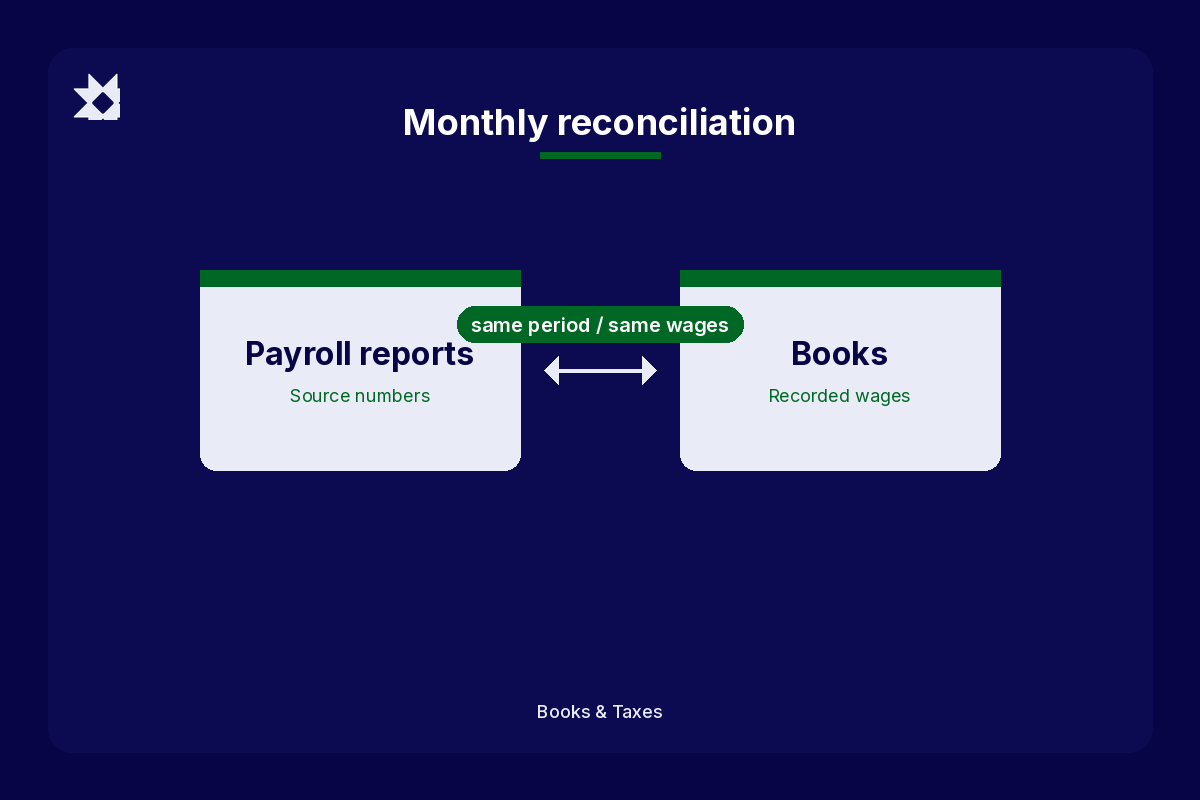
- Same period. Compare a calendar month in payroll to the same calendar month in the books — not “last pay date” against “whatever cleared the bank.”
- Gross wages. Total wages/earnings from payroll reports should line up with wage expense (and related clearing accounts) in the books.
- Employer taxes. Employer-side payroll taxes on the reports should line up with what you recorded as expense and liability. Keep this high-level; form rules and rates change.
- Deductions. Employee withholdings and deductions (tax, benefits, garnishments) should land in the right liability or expense accounts — not as a lump that never clears.
You are not rebuilding payroll from scratch. You are proving the two systems describe the same month.
Monthly steps
Do this after (or as part of) your monthly bookkeeping close.
1. Pull the payroll summary for the calendar month
Export or print a payroll summary / register for the month you are closing. You want totals for gross wages, employee taxes/deductions, employer taxes, and net pay — by the same date range you will use in the books.
If your payroll runs cross month-ends, note which checks belong to which calendar month. Timing differences are normal; undocumented ones are not.
2. Pull books totals for the same month
From your books, pull payroll-related expense and liability activity for that same calendar month: wage expense, employer payroll tax expense, and payroll tax / deduction liabilities.
Use the same month boundaries as the payroll report. If you accrue or reverse entries, include them in the comparison so you are not comparing apples to oranges.
3. Compare gross wages
Match total gross wages on the payroll report to wage expense in the books (plus any wage-related clearing accounts your process uses).
If they differ, find out why before you move on. Common causes are listed below. Do not plug the difference with a journal entry you cannot explain in one sentence.
4. Compare employer taxes to the reports
Match employer tax amounts on the payroll reports to employer payroll tax expense (and related liabilities) in the books.
Stay conceptual here: you are checking that the month’s employer taxes were recorded, not rewriting filing instructions.
5. Check that liabilities moved when you paid or filed
Payroll liabilities should not only grow. When you deposit taxes or pay benefit/garnishment amounts, the liability accounts should go down.
You are looking for stuck balances — amounts that sit forever because a payment was coded to expense instead of the liability, or a payroll run never posted a liability at all. Do not invent deposit due dates while you review; confirm schedules with your payroll provider or tax pro.
6. Keep contractors off employee wage expense
If you pay independent contractors, those payments should not land in employee wage expense. Contractor costs belong in their own expense (and often need different information trails than W-2 wages).
Misclassified or miscoded contractor payments are a frequent source of “payroll does not match the books” confusion — and a compliance risk.
7. Document differences and flag a pro when needed
Write down any gaps you found, what you fixed, and what is still open. If you cannot explain a difference, hand it to your bookkeeper or tax professional instead of forcing the books to match.
A short month-end note (“gross wages matched; employer tax $X timing difference — see pay date Y”) is enough. Future you will need it.
Common mismatch causes
These show up often:
- Timing: pay date in one month, work period or bank clear in another
- Manual journals: wage or tax entries posted by hand that duplicate (or skip) the payroll feed
- Benefits and garnishments miscoded: amounts hitting expense instead of liability — or the reverse
- Owner draws treated as wages: owner distributions or draws coded like employee pay (or wages coded like draws)
- Missing payroll journal entry after a run: payroll happened in the real world, but nothing hit the books
- Partial imports: some earnings codes sync; others never do
Fix the process when the same cause repeats. One-off cleanup without a process change usually means the same mess next month.
Year-end payoff (without inventing deadlines)
When payroll and the books agree each month, year-end is mostly confirmation: W-2 / wage totals, employer tax expense, and liability accounts that make sense.
When they do not agree all year, year-end becomes forensic work — under time pressure, with more room for error. The monthly habit is the cheaper path. Exact filing dates and forms depend on your situation and current law; confirm those with your tax pro rather than relying on a blog post.
When payroll and the books will not line up
If payroll reports and the books will not line up, or you are unsure how taxes and deductions should be coded, talk to your bookkeeper or tax professional. The same advice applies as in the monthly checklist: guessing is more expensive than asking.
Optional: pair this habit with the simple monthly bookkeeping checklist so bank reconciliation and payroll matching happen in the same monthly block.
This article is educational, not tax, legal, or employment advice for your business. Payroll and employment tax rules change. Form 941 and California employment filings are mentioned only as familiar concepts — confirm current requirements, rates, and schedules with a qualified professional before you act.
Make payroll and the books talk once a month. Document what you compared. Flag what will not reconcile. That is how small employers stay ahead of mismatches — instead of meeting them all at once at year-end.